
English
Views: 0 Author: Site Editor Publish Time: 2026-01-09 Origin: Site

You need to know how many ounces are in a cup when you cook or bake. In the US, one cup is 8 fluid ounces, which is essential for accurate ounce to cup conversion.
| Measurement | Fluid Ounces |
|---|---|
| 1 cup | 8 |
Changing ounces to cups quickly helps you follow recipes. Sometimes, ounces refer to weight or volume. This distinction is important because using the wrong measurement can alter your food. For example:
Fluid ounces indicate volume, while ounces indicate weight.
8 ounces of flour weighs less than 8 fluid ounces of water.
Measuring things correctly ensures you achieve the same results each time.
Hengfeng manufactures cup-making machines that assist companies in accurately measuring ounces and cups for food packaging.
One cup is the same as 8 fluid ounces in the US. You should always look at your recipe’s measurement standard so you do not make mistakes.
A conversion chart helps you measure ingredients the right way. This saves time and stops you from wasting food when you cook or bake.
Countries use different cup measurements. In the UK, one cup is 10 fluid ounces. This can change how your recipe turns out.
Image Source: pexels
You often need a quick way to check ounce to cup conversion when you cook or bake. The chart below shows the most common conversions for both US and UK kitchens. You can use this table to find the right amount of ounces for your recipe. In the US, 1 cup equals 8 fluid ounces. In the UK, 1 cup equals 10 UK fluid ounces. This difference can change your results if you use recipes from different countries.
| Ounces | US Cups | UK Cups |
|---|---|---|
| 8 | 1 | 0.8 |
| 16 | 2 | 1.6 |
| 32 | 4 | 3.2 |
| 128 | 16 | 12.8 |
Tip: Always check which standard your recipe uses before you start. This helps you avoid mistakes and keeps your food tasting great.
Here is a visual chart to help you see the ounce to cup conversion at a glance:
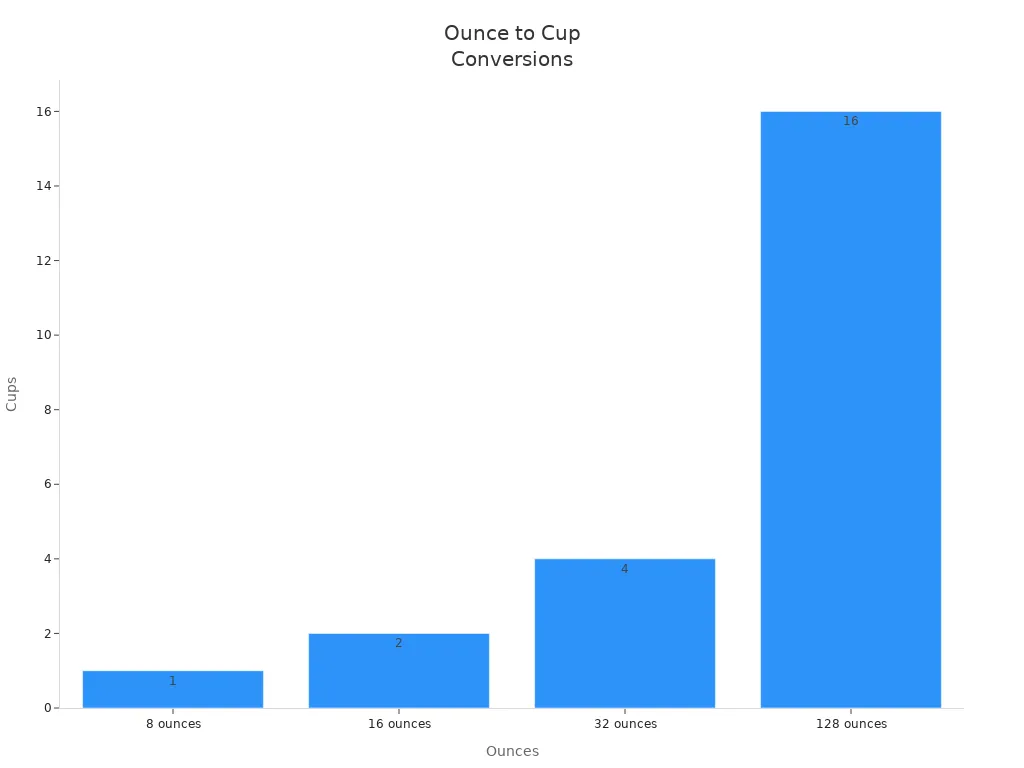
You use ounce to cup conversion every time you measure liquids or dry ingredients. If you want to make soup, you might need 32 ounces of broth. The chart shows that this equals 4 US cups. When you bake a cake, you may need 8 ounces of milk. The chart tells you this is 1 cup. You can follow recipes more easily when you know these conversions.
You should remember that UK and US measurements are not the same. If you use a UK recipe, 1 cup means 10 UK fluid ounces. If you use a US recipe, 1 cup means 8 fluid ounces. This small change can affect your results. You can use the chart to adjust your measurements and get the best outcome.
Hengfeng’s cup-making machines help companies measure ounces and cups with precision. Accurate ounce to cup conversion is important for food packaging and production. Hengfeng uses advanced technology to make sure every cup meets the right standards. You can trust Hengfeng’s machines to deliver reliable results in every batch.
Note: Using the right conversion keeps your food consistent and helps you avoid waste. You save time and ingredients when you measure correctly.
You can keep this chart in your kitchen for quick reference. You will find it useful for cooking, baking, and even packaging food at home or in a business.
You often see recipes that ask for cups or ounces. You may wonder how many ounces in 1 cup you need for your recipe. The answer depends on where the recipe comes from. In the United States, 1 cup equals 8 fluid ounces. In the United Kingdom, 1 cup is about 10 fluid ounces. This difference can change the way your food turns out.
Here is a table that shows the key differences between US and UK measurements:
| Measurement Type | US Measurement | UK Measurement |
|---|---|---|
| Fluid Ounce | 1 US fl oz = 29.5735 mL | 1 UK fl oz = 28.4131 mL |
| Cup | 1 cup = 8 US fl oz | 1 cup = 10 UK fl oz |
You can see that the size of a cup and the fluid ounce are not the same in both countries. If you use a UK recipe and measure with US cups, you may add less liquid than needed. If you use a US recipe and measure with UK cups, you may add too much. This can affect the taste and texture of your food.
You should also know that historical standards play a role. In the US, Fannie Farmer helped set the standard for how many ounces in 1 cup. In the UK, early kitchens used different measurements. Here is a table that shows some of these standards:
| Measurement Type | US Standard | UK Standard |
|---|---|---|
| Pint | 16 oz | 20 oz |
| Gallon | Based on British wine gallon | Larger gallon used in UK |
| Cup | Standardized by Fannie Farmer | Varied measurements in early UK kitchens |
Tip: Always check the origin of your recipe. This helps you use the right amount of ounces and get the best results.
You need to know how many ounces in a cup for accurate cooking and baking. Precision helps you make food that tastes the same every time. If you use the wrong amount of ounces, your cake may be too dry or your soup may be too watery.
Here are some reasons why knowing how many ounces in 1 cup is important:
Precision in baking gives you consistent results.
Different regions use different standards for ounces and cups.
Professional bakers need exact measurements to avoid mistakes when making large batches.
You can avoid errors by using the correct conversion. If you follow recipes from other countries, you should always check if the recipe uses US or UK measurements. This helps you measure the right number of ounces and keeps your food tasting great.
Note: Accurate measuring saves you time and ingredients. You waste less food and get better results when you know how many ounces in a cup.
You can use a conversion chart to help you remember these differences. Keep the chart in your kitchen so you can check it whenever you need to measure ounces or cups.
Fluid ounces are used to measure liquids. This unit tells you how much space a liquid takes up. In the US, one fluid ounce is about 29.57 milliliters. You see fluid ounces on drinks, milk, and oils. The short way to write fluid ounce is fl oz. Both the US and Imperial systems use fluid ounces.
| Definition | Details |
|---|---|
| Unit Type | Fluid Ounce |
| Measurement | Liquid Volume or Capacity |
| Abbreviation | fl oz |
| Equivalence | 1 US fluid ounce = 1/16 of a US pint, 1/8 of a US cup, ≈ 29.57 milliliters |
Tip: Fluid ounces show volume, not weight. Always look at your recipe to see if it wants fluid ounces or ounces by weight.
Ounces are used to measure how heavy solids are. This unit tells you the weight of an item. You see ounces for flour, sugar, and other dry things. One ounce is about 28.35 grams. Ounces by weight do not tell you how much space something fills. You need to know how many ounces in a cup to measure right.
| Measurement Type | Definition | Example |
|---|---|---|
| Ounce (oz) | Weight | 1 oz of any solid item |
| Fluid Ounce (fl oz) | Volume | 1 fl oz of liquid (e.g., water) |
Different foods have different densities. This means fluid ounces and ounces by weight can give you different results. For example, one cup of water weighs 8 ounces. One cup of honey weighs 12 ounces. One cup of oil weighs less than 8 ounces. You see this when you measure flour and sugar. Four fluid ounces of flour is 130 grams. Four fluid ounces of sugar is 200 grams.
| Ingredient | Weight (grams) | Volume (fluid ounces) |
|---|---|---|
| Flour | 130 | 4 |
| Sugar | 200 | 4 |
Note: Always check if your recipe uses fluid ounces or ounces by weight. This helps you get the right amount and keeps your food tasting good.
When you follow recipes, you may need to change ounces to cups. There is an easy way to do this the right way. First, check if you are measuring a liquid or something dry. For liquids, use a clear cup with ounce lines. Put the cup on a flat table and look at it straight on. For dry things, use a dry measuring cup. Fill the cup with a spoon until it spills over. Use a knife to make the top flat. If the dry food is lumpy, use a sieve or whisk before you measure.
Here is a table that shows how to change ounces to cups for some foods:
| Measurement Type | Ounces | Cups |
|---|---|---|
| Fluid Ounces to Liquid Cups | 8 fluid ounces | 1 cup |
| Dry Ounces to Cups (Flour) | 4.5 ounces | 1 cup |
You can see that the number of ounces in a cup depends on what you are measuring. Liquids use fluid ounces. Dry foods like flour use dry ounces.
It is important to know if you are measuring a liquid or a dry food. Liquids always have the same volume, so 8 fluid ounces is always 1 cup. Dry foods can be different because of how you fill the cup. For example, a cup of flour can weigh between 110 and 155 grams. If you pack flour tightly, you get more ounces than if you pack it loosely.
The right measuring tools help you get the right answer.
Different foods have different weights, so weight and space are not always the same.
How you fill the cup, like scooping or spooning, changes the ounces in a cup.
If you want to change ounces to cups for butter or other solid foods, remember these can be hard to measure by space. Always look at your recipe to see the best way. You will get better results if you measure carefully.
Tip: Always use the right cup for liquids and dry foods. This makes it easier to change ounces to cups and get it right.
It can be hard to change ounces to cups in food packaging. People sometimes mix up fluid ounces and ounces by weight. This mistake can mess up recipes and packaging.
Many people think fluid ounces and ounces by weight are the same. One cup is eight fluid ounces, but it is not always eight ounces by weight. For example, two cups of foam packaging peanuts do not weigh one pound. That is sixteen ounces. You must remember this when you make bigger batches. It helps you get the right weight every time.
Hengfeng uses smart machines to help you avoid these problems. The machines help you measure ounces the right way. Hengfeng’s equipment makes your work better:
| Aspect | Impact |
|---|---|
| Efficiency | Machines help you use less energy and waste. Production moves faster. |
| Automation | Automated systems help stop mistakes and speed up work. |
| Quality | Machines make sure every cup is made the same way. |
You can count on Hengfeng to give you good results every time.
Ounce to cup conversions help you in many parts of food packaging. Here are some ways you use them:
In cafés, knowing a 10oz biodegradable cup is 1.25 cups helps you make drinks and froth milk.
In meal prep, a 300ml compostable bowl gives even servings and keeps nutrition balanced.
In home kitchens, 300ml of cream is just over 1¼ cups. This helps you measure recipes right.
You need fast conversions to keep your service quick and customers happy. Good portioning saves money and keeps food quality high. Sometimes, standard conversions do not work for you. A quick guide for common sizes helps a lot.
Hengfeng’s machines help you measure ounces right and keep your business working well.
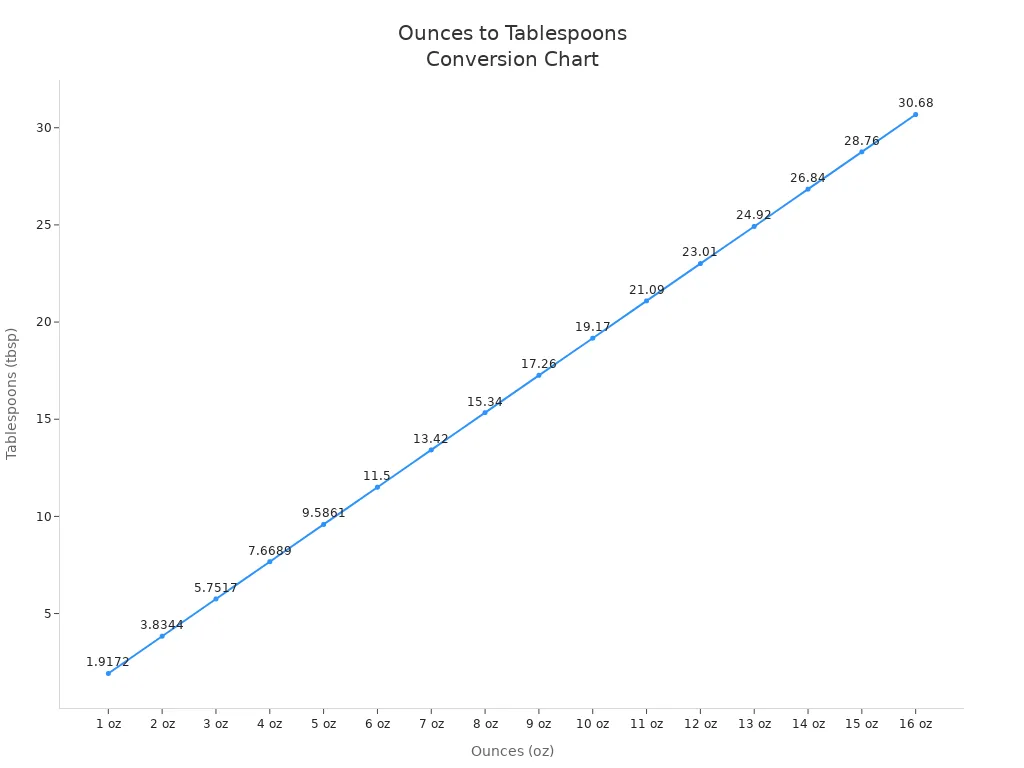
You often need to change ounces to tablespoons or teaspoons when you follow recipes. This helps you measure small amounts of ingredients. In US kitchens, one ounce equals about 1.92 tablespoons. You can use the table below to find the right conversion for your needs.
| Ounces | Tablespoons |
|---|---|
| 1 | 1.9172 |
| 2 | 3.8344 |
| 4 | 7.6689 |
| 8 | 15.34 |
| 16 | 30.68 |
You can see how the number of tablespoons grows as you add more ounces. If you want a visual guide, check the chart below.
You may need to convert ounces to milliliters when you use international recipes. One US fluid ounce is about 29.57 milliliters. This makes it easy to measure liquids if your tools use metric units.
| Measurement Type | Value |
|---|---|
| 1 US fluid ounce | approximately 29.5735 milliliters |
If you have a recipe that calls for 4 ounces, you need about 118 milliliters.
You can measure ingredients more accurately with a few simple tricks:
Use a kitchen scale for dry ingredients. This gives you the best results.
Use a fluid measuring cup for liquids. Read the line at eye level.
If a recipe lists ounces for dry items, always use a scale.
If a recipe lists ounces for liquids, use a wet measuring cup.
Accurate measuring helps you get the same results every time. You waste less food and save time.
You can keep these tips handy in your kitchen. They help you measure ounces and cups with confidence.
Image Source: pexels
You can make cooking and baking simpler with a printable ounce to cup conversion chart in your kitchen. This chart lets you find how many ounces you need for recipes fast. You do not have to guess or do math each time you cook. Many people like free printable charts because they help change recipes from US units to metric units quickly. Some people even draw their own charts for a special touch.
| Format Type | Description |
|---|---|
| Free Printable Chart | Handy for converting recipes from US customary units to metric quickly. |
Having a chart ready means you can check measurements quickly. You can double or cut recipes in half without making mistakes. You also avoid errors if you cannot find your measuring tools. The chart helps you change recipes easily and supports quick fixes.
Helps you avoid mistakes when measuring ingredients.
Useful if you do not have measuring tools.
Makes it easy to change recipes as needed.
You should keep your ounce to cup conversion chart where you can see it. Put it on your fridge or inside a cabinet door. This way, you always know how many ounces you need for each recipe. The chart helps you get your recipes right and lets you make changes fast. You save time and make fewer mistakes when you cook.
| Benefit | Description |
|---|---|
| Quick Reference | Gives you fast access to conversions, so you do not make mistakes. |
| Reduces Cooking Time | Makes cooking faster by cutting down on guessing when you measure. |
| Prevents Measurement Errors | Helps you avoid mistakes from forgetting or mixing up conversions. |
You get the same results every time you cook. The chart helps you measure ounces the right way and keeps your food tasting good. You can trust your chart to help your recipes turn out well.
Knowing how many ounces are in a cup helps you get the same results every time you cook or work. You make your recipes better and save time when you measure ounces the right way.
Weighing your ingredients gives you better results, especially for baking.
Using scales and charts makes your work quicker and less messy.
Getting conversions right keeps your food good and cuts down on waste.
Put your chart somewhere you can see it easily. Practice changing ounces to cups often. Use pictures and check your answers with other ways.
You can print or download the chart so you can find it fast. If you want to learn more about making cups and packaging, Hengfeng shares tips about machines, how things are made, and what is new in the market.
You take the ounces and split by eight. This tells you how many cups you need for liquids in US recipes.
You use fluid ounces to measure liquids. You use ounces by weight for solids. Always look at your recipe to see which one to use.
Some recipes use ounces to be more exact. Ounces help you measure things better, especially when you bake or package food.


