
English
Views: 0 Author: Site Editor Publish Time: 2026-01-09 Origin: Site

1 cup is the same as 8 fluid ounces. You need to know about ounce measurements and cups for accurate cooking, baking, and packaging. Measuring fluid ounces and dry ounces helps you not make mistakes. Fluid ounces are used for liquids. Dry ounces are used for solids. Hengfeng’s advanced cup machines help keep things accurate in food and drinks.
| Feature | Contribution to Measurement Accuracy |
|---|---|
| Consistent heat and pressure | Makes sure cups are made the same way, so there are fewer changes. |
| Precision forming techniques | Keeps all cups the same size and shape. |
1 cup is the same as 8 fluid ounces. This fact helps you measure liquids the right way in recipes. Fluid ounces tell you how much space a liquid takes up. Dry ounces tell you how heavy a solid is. If you mix these up, your food might not turn out right. Always look to see if your recipe uses fluid ounces or dry ounces. This helps you avoid mistakes and keeps your food safe. Use the correct measuring tools for liquids and solids. Good tools help you cook better food. Hengfeng’s machines make sure cups are made the right way. This keeps food packaging safe and strong.
Image Source: pexels
You see the word "ounce" in many recipes and packaging labels. Ounce measurements can mean different things. The ounce comes from the Ancient Roman unit 'uncia', which means 'one-twelfth part'. Over time, people started using ounces for both weight and volume. This can make ingredient conversions confusing.
Fluid ounces measure volume. You use fluid ounces for liquids like water, milk, or juice. Dry ounces measure weight. You use dry ounces for solids like flour, sugar, or nuts. If you mix up fluid ounces and dry ounces, you might get the wrong amount of an ingredient.
Here is a table to help you understand the difference between fluid ounces and dry ounces:
| Measurement Type | Definition | Example |
|---|---|---|
| Ounce (oz) | Weight | 1 oz of any solid substance |
| Fluid Ounce (fl oz) | Volume | 1 fl oz of liquid (e.g., water) |
| Water | 1 cup (8 fl oz) weighs 8 oz | 8 fl oz of water = 8 oz |
| Honey | 1 cup (8 fl oz) weighs 12 oz | 8 fl oz of honey = 12 oz |
| Oil | 1 cup (8 fl oz) weighs less than 8 oz | 8 fl oz of oil < 8 oz of water |
You use fluid ounces for measuring liquids. You use dry ounces for measuring solids. For example, 1 cup of water equals 8 fluid ounces and weighs 8 ounces. If you measure honey, 1 cup equals 8 fluid ounces but weighs 12 ounces. Oil is lighter, so 1 cup equals 8 fluid ounces but weighs less than 8 ounces.
Here is another table showing common uses:
| Measurement Type | Ounces per Cup | Common Use |
|---|---|---|
| Fluid Ounces | 8 | Liquids |
| Dry Ounces | 4.5 | Dry Ingredients |
You need to know the difference when you do cooking conversions or ingredient conversions. This helps you get the right amount for your recipes.
Ounce measurements help you make food that tastes good and looks right. If you use the wrong amount, your recipe might not work. You need to measure ounces to cups correctly. This keeps your food safe and tasty.
Tip: Always check if your recipe uses fluid ounces or dry ounces. This helps you avoid mistakes.
If you measure wrong, you can run into problems:
You might use too much or too little of an ingredient.
You can make food unsafe, especially with raw meat or eggs.
You might undercook food, which can cause foodborne illness.
Ingredients like salt, sugar, and baking soda need precise amounts for chemical reactions.
The ounce can mean mass or volume, which can confuse you.
This confusion makes it hard to scale recipes.
If you mix up fluid ounces and dry ounces, your cooking results can change.
You need to use the right measuring tools for ounces to cups. This helps you get the best results. When you measure cups and ounces correctly, your recipes turn out better. You also keep your food safe for everyone.
Image Source: unsplash
People use cups a lot in recipes and packaging. In America, the standard cup helps measure liquids and solids. One US cup is 8 fluid ounces. It is also 236.59 milliliters. This makes it easier to follow American recipes. You can look at the table below for quick facts:
| Measurement | Value | Unit |
|---|---|---|
| Standard U.S. cup | 236.59 | milliliters |
| Standard U.S. cup | 8 | fluid ounces |
It is important to use the right cup size when cooking. Using a different cup can change your ingredient amounts. Hengfeng’s machines help companies make cups that match these standards. This keeps packaging safe and correct.
Cups are not the same size everywhere. Recipes from Australia, the UK, and Canada use different cups. The Australian and UK cup both hold 250 milliliters. The US cup is a little smaller at 240 milliliters. You can see these sizes in the table below:
| Country | 1 Cup |
|---|---|
| Australia | 250ml |
| UK | 250ml |
| US | 240ml |
Many places use the metric cup, which is 250 milliliters. In America, there are two cup sizes. The customary cup is 240 milliliters. The legal cup is 236 milliliters. The legal cup is used on nutrition labels. The chart below shows cup sizes in different countries:
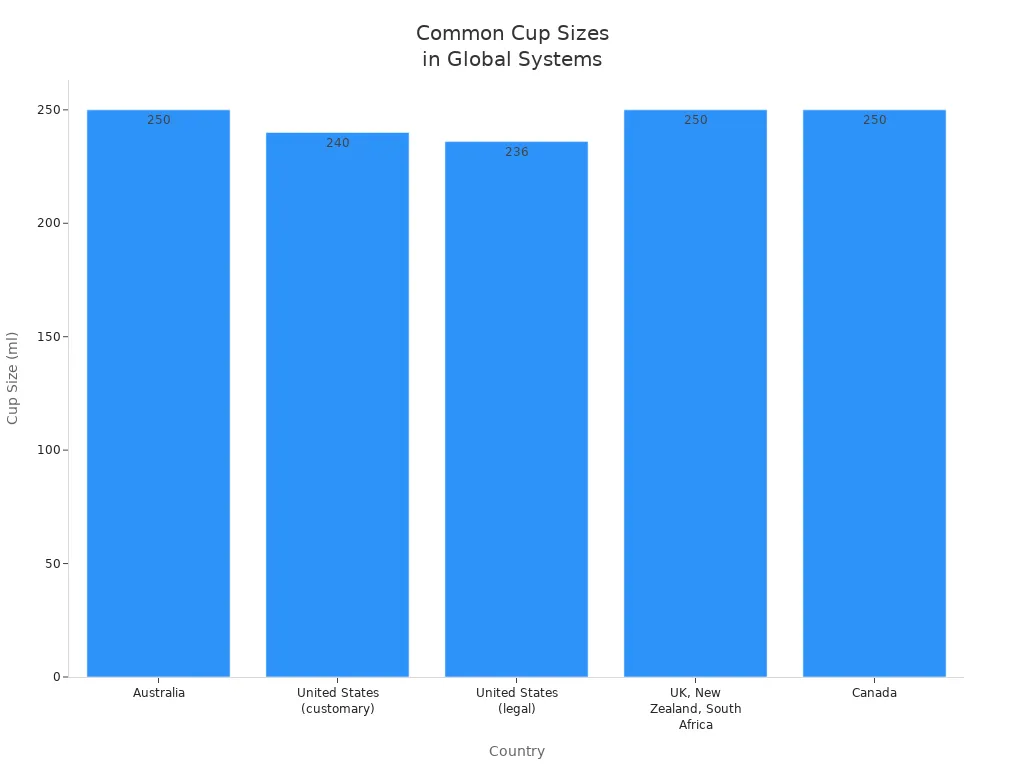
You should check the cup size before you start measuring ingredients. This helps you get the right amount for your recipe. Hengfeng’s machines help companies make cups that fit these world standards. This helps keep food packaging safe and correct.
Tip: Always check where your recipe comes from. This helps you pick the right cup and measure fluid ounces the right way.
When you work with ounce measurements in cooking or baking, you need to know how to convert ounces to cups. This helps you measure liquids and dry ingredients correctly. You can avoid mistakes and make sure your recipes turn out well.
You often see ounces and cups in recipes. You need to know how to switch between them. The most common conversion is for fluid ounces. One cup equals 8 fluid ounces. You can use a simple formula to help you:
| Conversion Type | Formula |
|---|---|
| Ounces to Cups | cups = fluid ounces ÷ 8 |
| Cups to Ounces | ounces = cups × 8 |
You can use this table when you need to change ounces to cups or cups to ounces. For example, if you have 16 fluid ounces, you divide by 8. You get 2 cups. If you have 3 cups, you multiply by 8. You get 24 fluid ounces.
Here is a table with common conversions you might use in the kitchen:
| Measurement | Conversion |
|---|---|
| 1 fluid ounce | 2 tablespoons |
| 1 cup | 8 fluid ounces |
| 1 pint | 2 cups or 16 fluid ounces |
| 1 quart | 2 pints or 32 fluid ounces |
| 1 gallon | 4 quarts or 128 fluid ounces |
You can see that ounce measurements help you understand how much liquid or dry ingredient you need. You can use these conversions for many recipes.
Tip: Always use the right measuring cup for liquids or dry ingredients. This helps you get the best results.
You should remember that liquid measurements are standard. One cup always equals 8 fluid ounces. Dry measurements can change depending on the ingredient. For example, a cup of flour weighs less than a cup of butter. You need to check your recipe to see if it uses fluid ounces or dry ounces.
Liquid measurements use cups, pints, quarts, and gallons.
Dry measurements use teaspoons, tablespoons, cups, or weight.
For liquids, 1 cup equals 8 fluid ounces.
For dry ingredients, 1 cup is about 4.5 ounces, but this can change.
You need quick answers when you cook or bake. Many chefs use conversion charts to help them measure ingredients fast. These charts help you scale recipes and keep your measurements accurate.
Here is a chart that shows fluid ounce to cup conversions for common measurements:
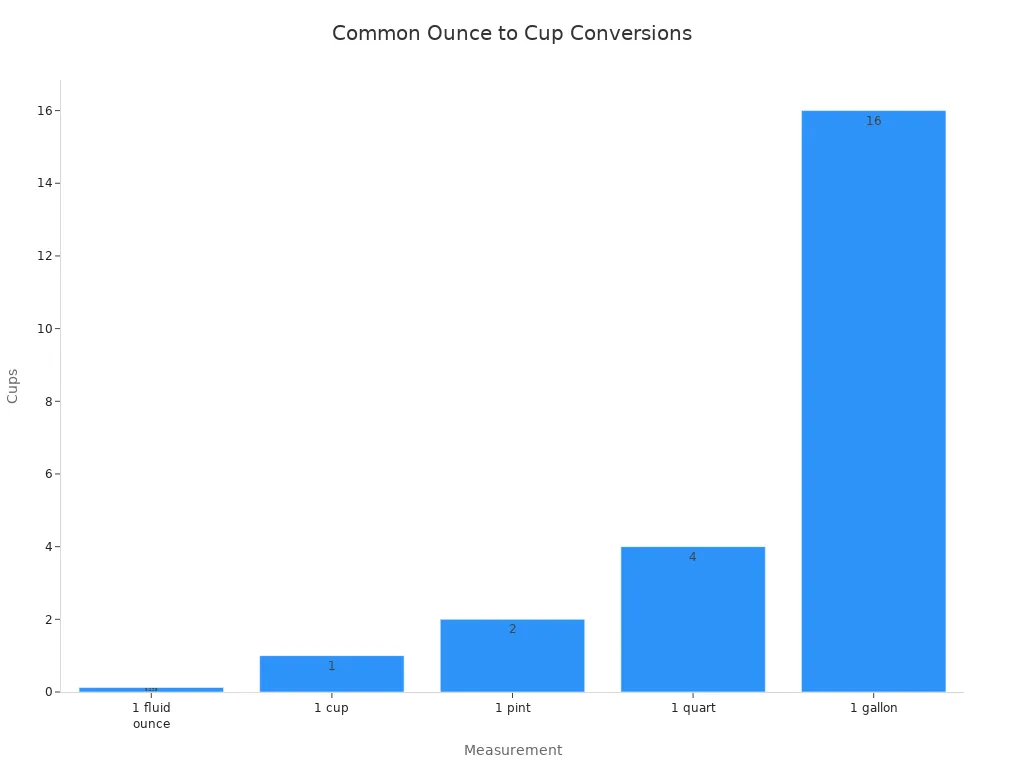
You can use this chart when you need to change ounces to cups. It helps you save time and avoid mistakes. You can also use the conversion table above for quick checks.
If you want to convert ounces to cups, you divide the number of fluid ounces by 8. If you want to convert cups to ounces, you multiply the number of cups by 8. This makes it easy to measure liquids and dry ingredients.
Note: Always check if your recipe uses fluid ounces or dry ounces. This helps you measure the right amount and keeps your food safe.
You can use these tips and tables every time you cook or bake. You will get better results and make fewer mistakes. Ounce measurements and cups are important tools in your kitchen.
You need good measuring tools to change cups to ounces. The right tool helps you get the right amount every time. Measuring cups from brands like Pyrex, OXO, Progressive International Prepworks, and Norpro have clear marks for cups and ounces. These cups help you measure flour, sugar, or butter easily.
| Brand | Description |
|---|---|
| Pyrex | High-quality cups with clear marks for cups, ounces, and milliliters. |
| OXO | Easy-to-hold kitchen tools, including measuring cups. |
| Progressive International Prepworks | Many measuring cups from trusted brands, so you get good quality. |
| Norpro | Strong plastic measuring cups that are safe for food. |
Good measuring cups are very accurate. They are usually off by only 1-2%. Cheap cups can be wrong by 10% or more. A kitchen scale helps you measure ounces even better, especially when baking.
Chef Terry John Zila says, "If you measure right, your baked goods will be great. If you use too much flour, pie crusts won’t roll, bread gets tough, and cakes turn hard."
You can stop mistakes when changing cups to ounces by doing these things:
Use the right measuring cup for liquids or dry things.
Don’t pack flour too tightly in a dry cup. This adds extra flour.
Pour liquids into a liquid cup to avoid spills.
Fluid ounces measure volume. Ounces measure weight.
Always check your recipe for the right conversion.
Weighing ingredients makes baking more consistent. Even small mistakes can change your baked goods. Measuring right helps you follow recipes and keeps food safe.
Measuring right stops you from eating too many nutrients. This is important for people with special diets.
Using a kitchen scale helps keep nutrients the same each time.
Hengfeng’s machines help companies make cups with exact measurements. Smart machines control every step, so cups are always the same. Quick-change systems let workers switch cup sizes fast and keep measurements correct. Servo motors and controls help keep cups accurate when making them. The cam-driven system makes cups strong and fast, and it lowers mistakes.
| Feature | Description |
|---|---|
| Smart Automation | Machines control every step, so cups are always the same. |
| Quick-Change Systems | Workers can switch cup sizes quickly and keep measurements right. |
| Servo Motors and Controls | Special controls keep cups exact during production. |
| Cam-Driven System | Makes cups strong and fast, and lowers mistakes. |
In big food factories, best practices use standard units, change volume to weight, and use scales for accuracy. Hengfeng’s machines help companies follow these rules. This helps them make safe and reliable packages for all cooking ingredients.
You now know that 1 cup is 8 fluid ounces. Using the right cups and ounces helps you bake and cook well. If you use a converter or a table, you make fewer mistakes. This keeps your recipes the same every time. Measuring tablespoons and changing them to cups helps your food taste good. It is important to know the difference between volume and weight. Hengfeng’s machines help big companies keep food fresh. They also help lower waste. You can trust their technology for good packaging.
| Key Takeaway | Details |
|---|---|
| Accurate measurements | Needed for recipes to work |
| Using conversion tables | Stops you from making mistakes |
| Hengfeng’s cup machinery | Keeps food fresh and high quality |
One standard US cup has 8 fluid ounces. Most American recipes use this measurement.
Use a dry measuring cup for solids. Use a liquid measuring cup for liquids. This makes your measurements more accurate.
Some recipes measure weight with ounces. Other recipes measure volume with cups. Always check your recipe to avoid mistakes.
A US cup holds 240 milliliters. A metric cup holds 250 milliliters. Check where your recipe comes from to use the right cup.
Hengfeng’s machines make cups with exact sizes. This helps food companies package things safely and correctly.


