
English
Views: 0 Author: Site Editor Publish Time: 2026-01-09 Origin: Site

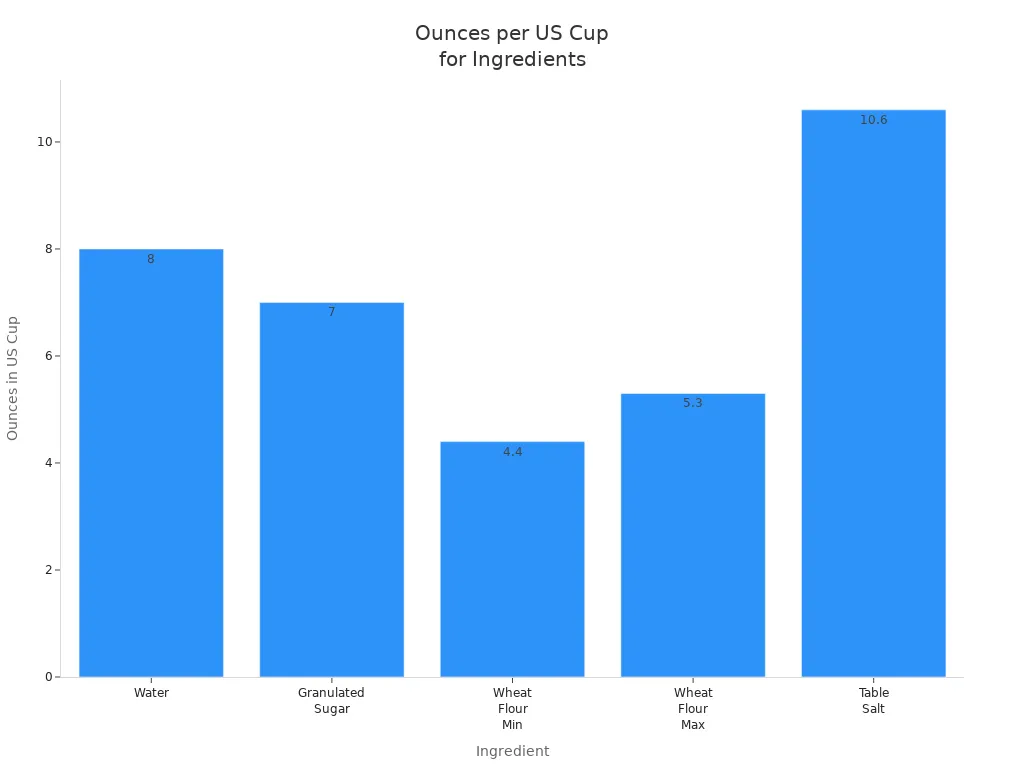
You need to know exactly how many ounces are in a cup for both dry and liquid ingredients. A liquid cup holds 8 ounces. Dry ingredients vary; for example, a cup of flour is about 4.4 to 5.3 ounces. See the table below:
| Ingredient | US Cup (oz) |
|---|---|
| Water | 8 |
| Granulated Sugar | 7 |
| Wheat Flour | 4.4 - 5.3 |
| Table Salt | 10.6 |
You often face this challenge when baking. Using the right cup measurements helps you get perfect results. Hengfeng values precision and quality. With a few tips, you can convert ounces to cups with confidence.
One cup of liquid is the same as eight fluid ounces. You can use this easy conversion to measure liquids correctly.
Dry ingredients do not all weigh the same in one cup. Always look at ingredient charts to get exact conversions.
Use liquid measuring cups for liquids. Use dry measuring cups for dry ingredients. This helps you measure right and cook better.
When you measure ingredients in the kitchen, you often ask how many ounces in a cup. The answer depends on whether you measure liquids or dry items. You need to know the difference to get the best results in cooking and baking.
In the United States, the standard conversion for liquids is simple. One cup equals eight fluid ounces in a cup. You can see this in the table below:
| Measurement | Value |
|---|---|
| 1 fl oz (US) | 0.125 cup (US) |
| 1 cup (US) | 8 fl oz (US) |
You use this conversion for water, milk, juice, and other liquids. If a recipe calls for two cups of milk, you know that means sixteen fluid ounces in a cup. This standard makes measuring liquids easy and reliable.
Tip: Always use a clear liquid measuring cup for liquids. Place the cup on a flat surface and check the measurement at eye level.
Hengfeng values precision in manufacturing, just like you need accuracy in your kitchen. Hengfeng’s machines reach ±50 nanometer accuracy in each cavity and 99.7% consistency in molding quality. This level of precision ensures you get reliable and consistent kitchen tools, helping you measure liquids with confidence.
Dry ingredients do not follow a single rule for how many ounces in a cup. The weight of a cup changes based on the ingredient’s density. For example, a cup of flour weighs less than a cup of sugar. You can see the differences in the table below:
| Ingredient | Weight (ounces) | Weight (grams) |
|---|---|---|
| All-purpose flour | 4.5 | 125 |
| Chocolate chips | 6 | N/A |
| Cocoa powder | N/A | 120 |
| Sugar | N/A | 200 |
| Brown sugar | N/A | 220 |
| Butter | N/A | 226 |
| Water | N/A | 236 |
| Milk/Cream | N/A | 240 |
Different ingredients have varying densities, so the conversion from ounces to cups changes. For example, a cup of flour weighs about 4.4 ounces, while a cup of sugar weighs about 7 ounces. The chart below shows how ingredient density affects the weight per cup:
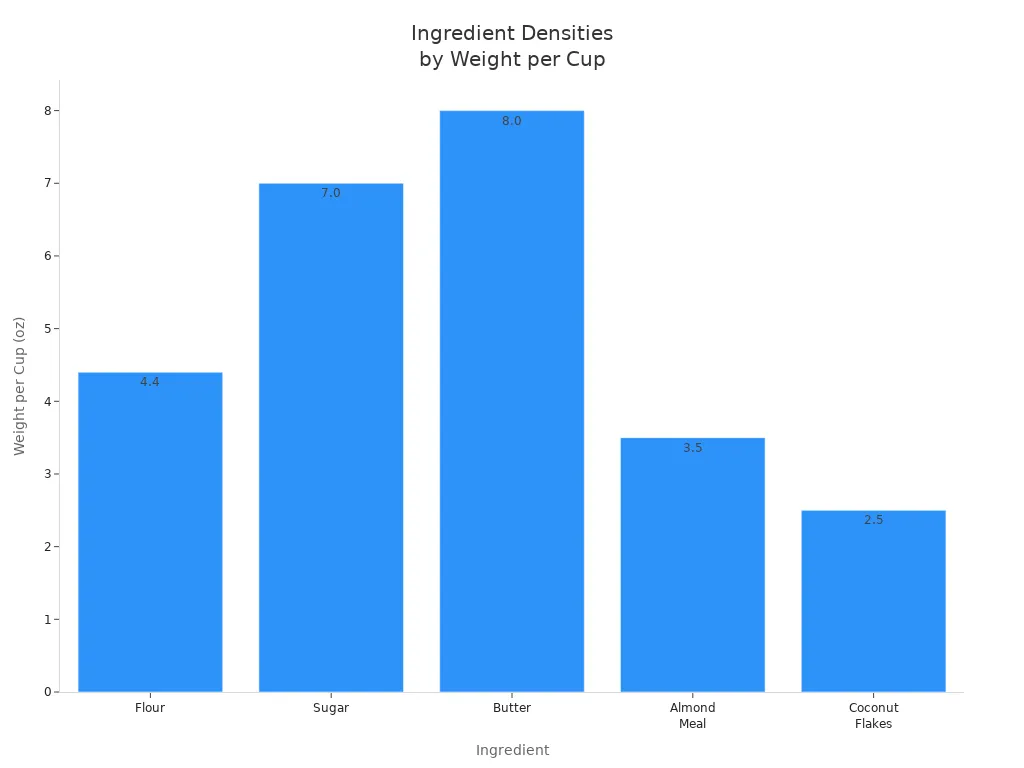
You must consider density for accurate conversion. If you use a liquid measuring cup for dry ingredients, you may get the wrong amount. Always use a dry measuring cup and level off the ingredient for best results.
A cup of flour weighs less than a cup of sugar because flour is less dense.
For nuts or coconut flakes, the weight per cup is even lower.
Recipes often list dry ingredients by weight for accuracy.
Note: Ounces measure weight, while cups measure volume. You need to know the density of each ingredient for a correct conversion.
Hengfeng’s commitment to precision matches the need for accuracy in your kitchen. Just as Hengfeng uses high-quality materials and strict quality control, you should use the right measuring tools and methods for each ingredient. This approach helps you achieve perfect results every time.
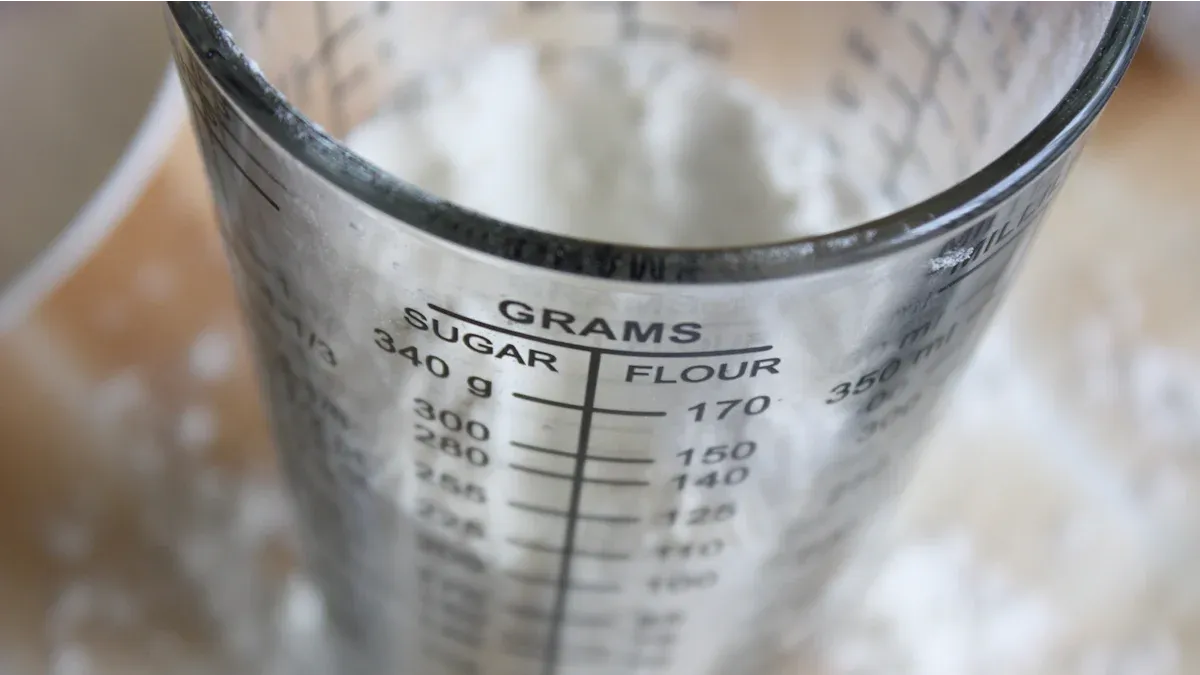
Image Source: unsplash
It is important to know about dry and liquid measuring cups. Dry measuring cups are good for flour and sugar. You fill the cup all the way and level it off. Use a straight edge to make it even. This helps you get the right amount. Liquid measuring cups have a spout and extra space. You pour the liquid in and look at the line. Check the amount at eye level. This design stops spills and helps you measure right. How you use each cup can change your results.
| Ingredient Type | Recommended Tools | Techniques |
|---|---|---|
| Liquid Ingredients | Liquid Measuring Cups | Look at the measurement at eye level, do not overfill, and check the meniscus for accuracy. |
| Dry Ingredients | Dry Measuring Cups, Measuring Spoons | Fluff and spoon the ingredient, then level with a straight edge for the best measurement. |
You need to use the right cup for each ingredient. If you use the wrong cup, you might add too much or too little. This can change how your food tastes and feels. Here are some reasons why this is important:
The right measuring cup gives you the correct amount, which helps your recipe work.
Using different cups for dry and liquid ingredients keeps things the same every time you cook or bake.
If you measure wrong, your food can turn out different, and the texture or flavor may change.
You want your recipes to be good every time. Hengfeng cares about making products with quality and precision. You can do this in your kitchen by picking the right tools for measuring cups.
You can convert ounces to cups for liquids with a simple formula. This method helps you measure water, milk, or juice with accuracy. Follow these steps to convert fluid ounces to liquid cups:
Find the number of fluid ounces you want to convert.
Use the formula: cups = fluid ounces ÷ 8.
Divide the fluid ounces by 8 to get the number of cups.
For example, if you have 16 fluid ounces, divide 16 by 8. You get 2 cups.
Tip: Always use a clear measuring cup for liquids. Place it on a flat surface and check the line at eye level for the best results.
This formula works for all standard liquid ingredients. You can use it every time you need to convert fluid ounces to liquid cups.
Dry ingredients need a different approach. You cannot use the same formula for dry ounces to cups because each ingredient has a different density. For example, flour and sugar fill a cup in different ways. Professional bakers recommend weighing dry ingredients for the best accuracy. Measuring by weight gives you the same amount every time, no matter how you fill the cup.
Weighing dry ingredients saves time and reduces mess.
A digital scale gives you more accurate results than using cups.
You get consistent baked goods when you weigh your ingredients.
Measuring by weight is the gold standard. A gram or an ounce of flour always stays the same, but a cup can change. If you want to convert dry ounces to cups, check the recipe or use a chart for that specific ingredient.
Note: For the most reliable results, use a scale for dry ingredients and a measuring cup for liquids.
Image Source: pexels
You need the right tools to measure well in your kitchen. Use dry measuring cups for things like flour and sugar. Pick liquid measuring cups for water, milk, and other liquids. Clear cups help you see the lines better, so you can measure the right amount. Keep your measuring cups safe so they do not bend or break. If you want the best results, use a digital kitchen scale. Hengfeng cares about being exact and reliable, just like you should when you measure for recipes.
Put your cup on a flat surface before adding anything. This step helps you avoid mistakes. When you use liquid measuring cups, look at the amount at eye level. You will see the meniscus, which is the curve at the top of the liquid. This way, you get the right measurement. For dry measuring cups, make sure the cup is flat before you fill it. Doing this helps you get the right amount every time.
It is important to know how to measure dry ingredients for baking and cooking. Follow these steps to level dry ingredients:
Use dry measuring cups that match the amount you need.
Spoon or scoop the ingredient into the cup until it goes over the top.
Do not press the ingredient down.
Use a straight edge, like a knife, to scrape off the extra.
Leveling dry ingredients with a straight edge takes away the extra and gives you the right amount. This method is important for things like flour or sugar. If you need to measure brown sugar, press it into the cup if the recipe says "packed," then level it off. These steps help you get the same results every time.
Tip: Always use the right cup for each ingredient and level off dry ingredients for best results.
Hengfeng’s focus on being exact and reliable is like your goal for good measurements in the kitchen.
You often need a quick way to check ounces in a cup when you cook or bake. A conversion chart helps you find the right amount fast. You can use these tables and charts to make sure your measurements are correct every time.
You measure liquids like water, milk, or juice using fluid ounces in a cup. The table below shows how many ounces in a cup for common amounts:
| Fluid Ounces (oz) | US Cups |
|---|---|
| 8 oz | 1 cup |
| 16 oz | 2 cups |
| 24 oz | 3 cups |
| 32 oz | 4 cups |
| 64 oz | 8 cups |
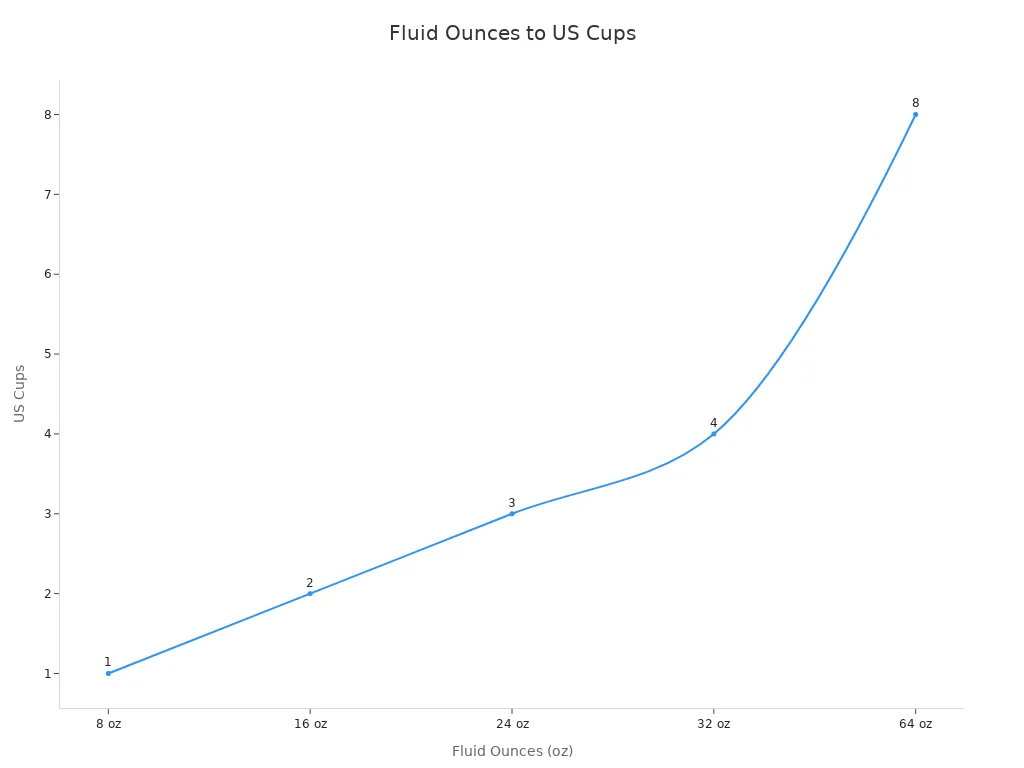
You can see that one cup always equals eight fluid ounces in a cup. This makes liquid measuring simple and reliable.
Dry ingredients have different ounces in a cup because each ingredient has its own density. The table below shows how many ounces in a cup for popular dry ingredients:
| Ingredient | Ounces in a Cup | Grams |
|---|---|---|
| All-purpose flour | 5 | 142 |
| Cake flour | 4 | 113 |
| Whole wheat flour | 5.5 | 156 |
| Granulated sugar | 7 | 198 |
| Packed brown sugar | 7 | 198 |
| Confectioners' sugar | 4 | 113 |
| Cocoa powder | 3 | 85 |
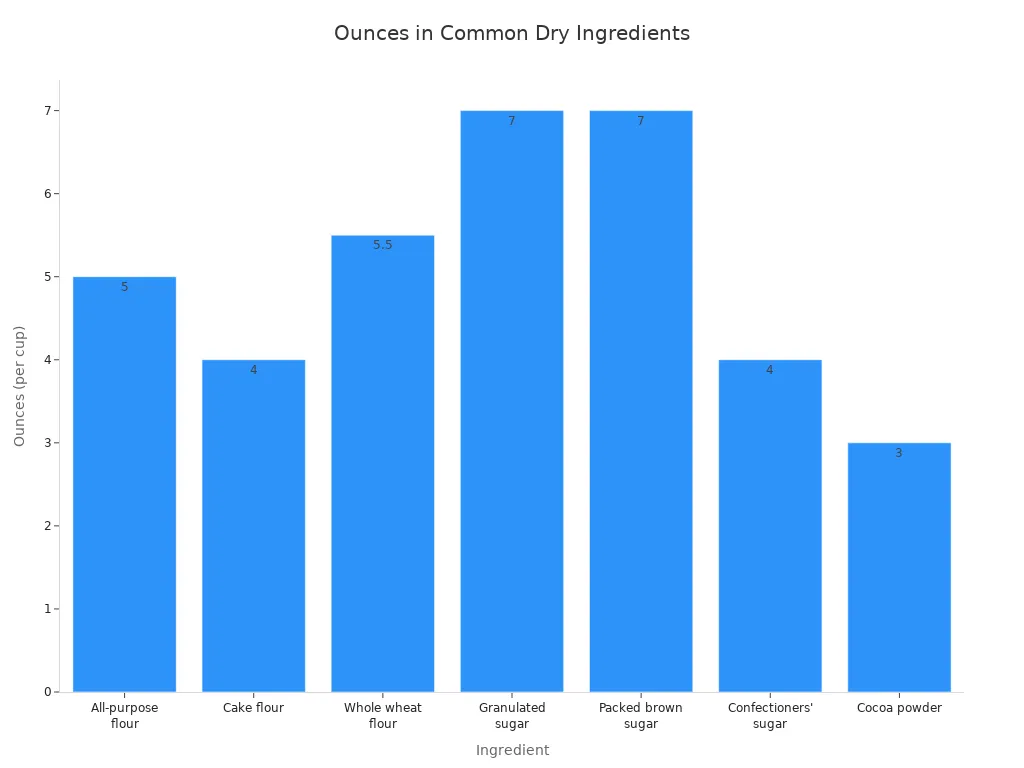
You should always check the conversion chart before you measure dry ingredients. This helps you get the right amount in each cup and keeps your recipes accurate.
Tip: Use these tables and charts as a guide every time you need to convert ounces in a cup. This habit will help you avoid mistakes and improve your cooking results.
You might think that all ounces are the same, but dry and liquid ounces measure different things. Dry ounces measure weight, while liquid ounces measure volume. If you use a liquid measuring cup for flour or sugar, you can end up with too many ounces. This mistake can change the texture of your food. For example, too many ounces of flour can make cookies dense. Too few ounces of sugar can make a cake less sweet. Always check if your recipe calls for dry or liquid ounces. Use the right measuring cup for each type.
Tip: Dry measuring cups are for dry ounces. Liquid measuring cups are for liquid ounces. This habit helps you avoid confusion and get the right amount of ounces every time.
Using the wrong cup can lead to big errors in your recipe. A dry measuring cup is best for flour, sugar, or cocoa powder. A liquid measuring cup is best for water, milk, or oil. If you use a liquid cup for dry ingredients, you might add extra ounces. This can affect the taste and nutrition of your food. The table below shows how much accuracy can change with different cups:
| Type of Measuring Cup | Discrepancy in Accuracy |
|---|---|
| Measuring Spoons | More than 30% |
| Dry Measuring Cups | Up to 6% |
| Liquid Measuring Cups | About 13% |
Always use the correct cup to measure ounces. This step keeps your recipes accurate and your results consistent.
Baking needs exact ounces for the best results. If you skip weighing dry ingredients, you risk using too many or too few ounces. This can make cakes dense or cookies flat. Baking is a science. You need the right ounces for each ingredient. Use a kitchen scale for dry ounces when you can. This tool gives you the most accurate ounces in every cup. If you only use cups, remember to spoon and level your dry ingredients. Never scoop directly from the bag, as this packs in extra ounces.
Use a spoon to fill the cup with dry ingredients.
Level off the top with a straight edge.
Store your cups safely to avoid dents that can change the ounces they hold.
Remember: Accurate ounces in every cup help you get the best taste, texture, and nutrition from your recipes.
You now know how many ounces are in a cup and why it matters. Using the right cup helps you measure how many ounces are in a cup for every recipe. Always check how many ounces are in a cup and how many fluid ounces are in a cup. With practice, how many ounces are in a cup becomes easy. Use the chart to see how many ounces are in a cup for dry and liquid ingredients. You will get better results when you know how many ounces are in a cup and use the correct cup every time.
You need to pick the right cup for each job. Use clear cups when you measure liquids. Use flat cups for dry things like flour or sugar. This makes your measurements more exact.
Dry and liquid ingredients fill cups in different ways. You must use the correct cup for each type. This helps you get the right amount every time.
You should not use the same cups for all things. Liquid and dry measuring cups have different shapes. This helps you measure better and get the right amount.


